Tolerances, Threads and Fits That Actually Work
How accurate a printed part really is, the clearances that produce a press fit rather than a jam, and how to get threads that survive being used.
The short answer
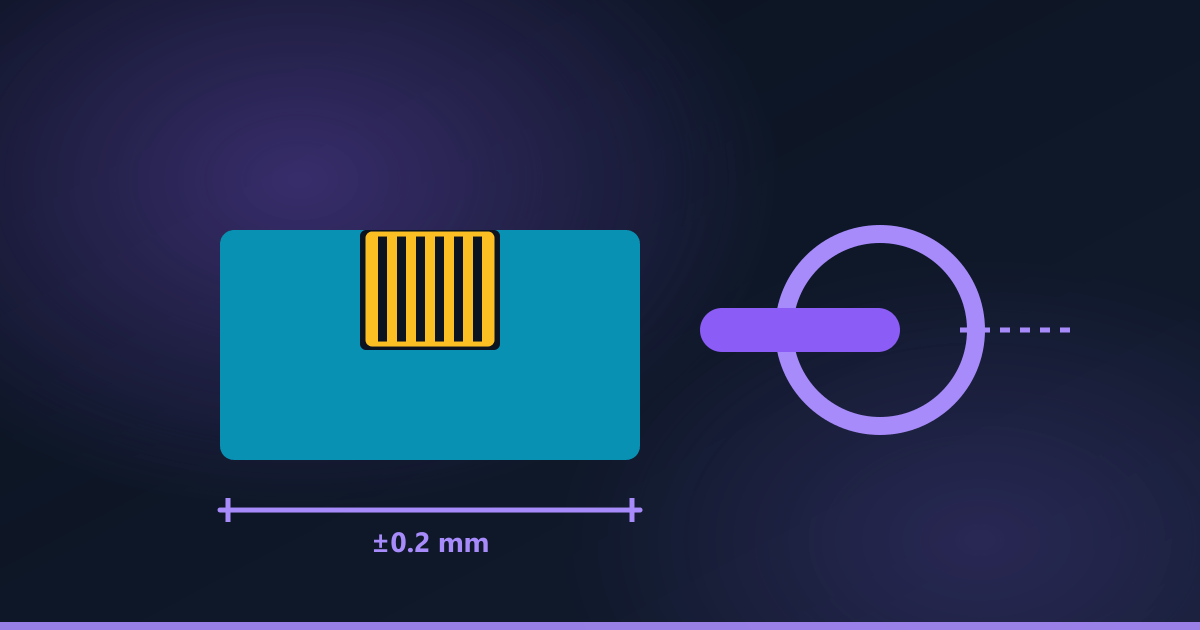
A well-tuned FDM printer holds roughly ±0.2 mm on most dimensions, with holes printing slightly undersize because of how plastic behaves at an inside curve. Design 0.2 mm of clearance for a press fit and 0.4 mm for a sliding fit, and use heat-set brass inserts rather than printed threads anywhere a fastener will be tightened more than a few times.
3D printing is often described as precise. It is repeatable, which is not the same thing. Knowing where the error lives is what lets you design a part that assembles first time.
What accuracy to expect
For a typical part on a well-maintained machine, expect around ±0.2 mm on external dimensions. That is excellent for brackets, enclosures and mounts, and not good enough for a bearing seat cut to a machining tolerance. The error is not random, though — it is systematic, and therefore correctable.
Holes print undersize. Always.
This is the single most useful thing on this page. The extruded plastic is laid along a curve and pulls very slightly inward as it cools, so a 10 mm hole typically measures nearer 9.8 mm. A shaft designed at exactly 10 mm will not go in.
| Fit you want | Add to the hole | Result |
|---|---|---|
| Press fit — stays put, needs force | +0.2 mm | Firm, no glue needed |
| Sliding fit — moves smoothly | +0.4 mm | Slides without slop |
| Free rotation — a shaft or hinge | +0.5 to 0.6 mm | Turns freely |
| M3 screw passing through | 3.4 mm hole | Clears without binding |
| M3 self-tapping into plastic | 2.5 mm hole | Screw cuts its own thread |
Threads: three options, in order of durability
Heat-set brass inserts — the best answer
A knurled brass insert is pushed into a slightly undersized hole with a soldering iron; the plastic melts around it and locks it in place. You get a real metal thread in a plastic part that can be assembled and disassembled hundreds of times. This is what commercial products do, and it is not difficult.
Captive nuts — free and nearly as good
Model a hexagonal pocket that a standard nut drops into, ideally so the print closes over it. Costs nothing, needs no tools, and gives a metal thread. The only drawback is that the pocket has to be designed in from the start.
Printed threads — for coarse, occasional use
A printed thread works if it is coarse — M8 and above, or a chunky custom profile like a bottle cap. Fine threads such as M3 print poorly and strip almost immediately. Print threads when the joint is assembled once or twice, not when it is a service point.
Where accuracy goes wrong
- The first layer is squashed into the bed on purpose, so the bottom 0.2 mm of every part is slightly wider — this is called elephant's foot, and a small chamfer on the bottom edge removes it.
- Tall thin features lean very slightly, so a 100 mm tower is less accurate at the top than at the base.
- Large flat parts can lift at the corners as they cool. Rounded corners and a wide first layer help.
- Two dimensions that must match should ideally be printed in the same orientation, since accuracy differs between axes.
When printing is the wrong process
If a feature needs to be accurate to better than a tenth of a millimetre, or a hole must be perfectly round and smooth, the practical answer is to print the part slightly undersize and finish that one feature by hand — drill the hole, or ream it. Printed parts are drilled and tapped all the time, and it is far easier than chasing the tolerance in the slicer.
Frequently asked questions
How accurate is 3D printing?
About ±0.2 mm on typical dimensions for a well-maintained FDM machine. That is fine for brackets, enclosures and mounts, and not enough for precision mechanical fits without finishing the critical feature by hand.
Why do my printed holes come out too small?
Because extruded plastic pulls inward slightly on an inside curve as it cools. A 10 mm hole commonly measures around 9.8 mm, so oversize the hole in the model by 0.2 mm for a press fit and 0.4 mm for a sliding one.
Can 3D printed threads hold?
Coarse ones can, for occasional use. Fine threads like M3 strip quickly. For anything repeatedly tightened, use a heat-set brass insert or a captive nut.
What size hole for an M3 screw?
3.4 mm for a clearance hole the screw passes through, and 2.5 mm for a hole the screw cuts its own thread into. For a permanent thread, use a heat-set insert sized to its own specification.
What is elephant's foot?
The slight bulge at the very bottom of a print, caused by the first layer being deliberately squashed into the bed for adhesion. A 0.5 mm chamfer on the bottom edge removes it entirely.
Got a file to print?
Instant price, delivered anywhere in Lebanon for a flat $5.