3D Printing Glossary: 40 Terms in Plain English
Forty 3D printing words explained in one or two plain sentences each, from infill and supports to STL, watertight and warping. No jargon, no settings.

The short answer
The five terms that come up in almost every 3D printing conversation are layer height (how thick each printed slice is), infill (the hidden pattern inside a part), walls (the solid outer skin that gives most of the strength), supports (temporary scaffolding under overhangs) and STL (the standard file a printer is fed from). The other 35 are below.
These are the words you will meet in a quote, a forum thread or a WhatsApp message about your part. Each one is explained as an idea, not as a number to set. If a word sends you to a longer read, the link is there.
The process
| Term | What it means |
|---|---|
| Additive manufacturing | The formal name for 3D printing: making a part by adding material, rather than cutting it away from a block. |
| FDM | Fused deposition modelling. A printer melts a plastic thread and draws the part layer by layer. It is what most services, including this one, use. |
| Resin printing (SLA) | A different process that hardens liquid resin with light. Finer detail, more brittle parts. See [FDM vs resin](/blog/fdm-vs-resin-3d-printing). |
| Filament | The plastic thread an FDM printer feeds on, sold wound on a spool. |
| Nozzle | The small heated tip the melted plastic comes out of. Its width limits how fine a detail can be. |
| Extrusion | Pushing melted plastic out of the nozzle. A line of it is called an extrusion or a line. |
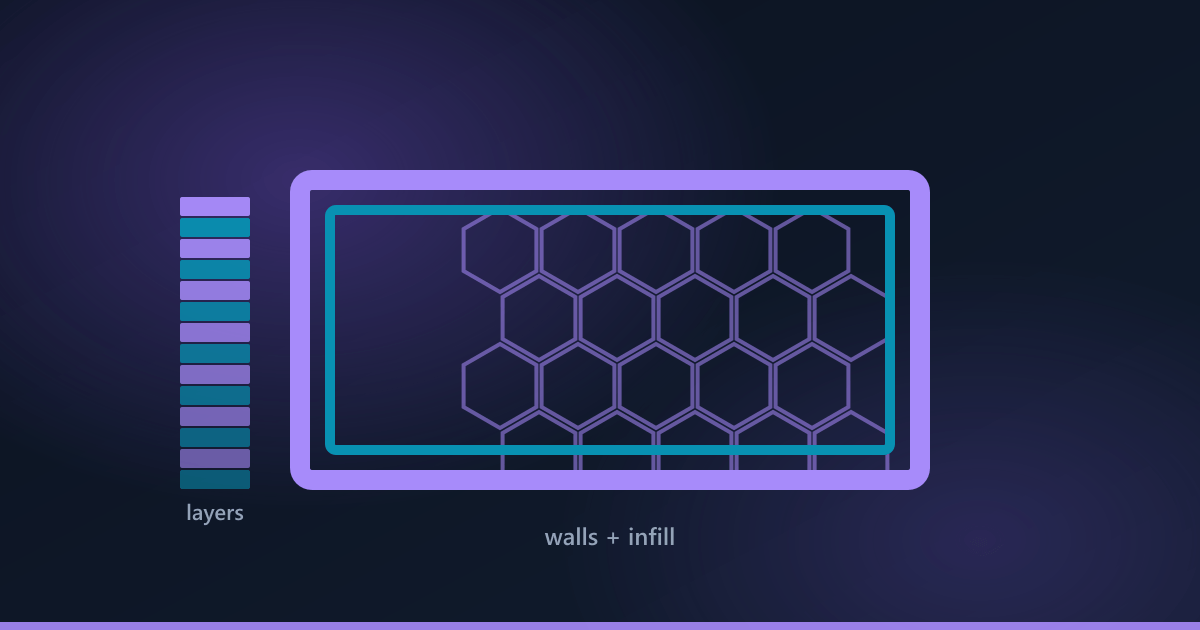
| Layer | One flat slice of the part. Printers build upwards one layer at a time. |
| Layer height | How thick each layer is. Thinner layers look smoother and take longer. Explained in [layer height, infill and walls](/blog/layer-height-infill-walls-explained). |
| Layer lines | The fine horizontal ridges on every FDM print, left by the layers. They can be sanded away but not avoided. |
| Build plate (print bed) | The flat surface the part is printed on. |
| Build volume | The biggest box a printer can make a part inside. Anything larger is printed in pieces and joined. |
| Print time | How long the machine runs for one job. Not the same as delivery time, which includes scheduling and the courier. |
Inside a part
| Term | What it means |
|---|---|
| Walls (perimeters) | The solid outline of each layer. Walls carry most of a part's strength. |
| Top and bottom layers | The solid skin that closes the part above and below. Together with the walls they form the shell. |
| Infill | The hidden lattice inside a part. More infill makes a part heavier and stiffer, and costs more. |
| Infill pattern | The shape of that lattice, such as a grid or honeycomb. It changes how the part behaves under load. |
| Solid part | A part printed with no hollow space inside. Heaviest and most expensive, rarely needed. |
| Strength option | On our quote form, the choice between Light, Standard, Strong and Solid, which sets how much plastic goes inside. |
Shapes and problems
| Term | What it means |
|---|---|
| Overhang | Part of a model that sticks out over nothing. Gentle slopes print fine; flat ones droop. |
| Supports | Temporary scaffolding printed under overhangs and snapped off afterwards. They leave rough marks where they touched. |
| Bridging | A layer printed across a gap between two supports, like a bridge. Short bridges work; long ones sag. |
| Brim | A thin flat ring printed around the base to help it grip the plate. Trimmed off afterwards. |
| Raft | A disposable platform printed under the part. Used less often today. |
| First layer | The layer touching the plate. If it does not stick, nothing above it works. |
| Warping | Corners lifting off the plate as the plastic cools and shrinks. Large flat parts are most at risk. |
| Stringing | Fine hairs of plastic between separate parts of a print. Cosmetic and easy to clean off. |
| Seam | The small mark where each layer starts and ends. It is usually placed where it shows least. |
| Elephant's foot | A slight bulge at the very bottom of a part, where the first layers are pressed flat. |
| Anisotropy | A print is weaker between layers than along them. That is why the way a part lies on the plate matters for strength. |
| Print orientation | Which way up a part is printed. It decides strength, finish and how many supports are needed. |
Files and fit
| Term | What it means |
|---|---|
| STL | The most common 3D printing file. It describes the outside surface as thousands of small triangles. |
| OBJ | Another mesh file, common from 3D art and scanning software. We accept STL and OBJ. |
| 3MF and STEP | Other formats. 3MF can carry colours and settings; STEP is an exact engineering format from CAD software. Export either to STL to upload. |
| Mesh | The surface of a model made of triangles, as in an STL file. |
| Watertight (manifold) | A mesh with no holes, so it has a clear inside and outside. Only watertight models print reliably. See [how to prepare an STL file](/blog/prepare-stl-file-for-printing). |
| Slicer | Software that cuts a model into layers and works out the path the nozzle will follow. |
| G-code | The list of machine instructions a slicer produces. The printer reads it line by line. |
| Units | Whether a file was saved in millimetres, inches or metres. A wrong unit makes a part arrive tiny or enormous. |
| Tolerance | How close to the drawn size a printed part comes out. Covered in [tolerances, threads and fits](/blog/3d-printing-tolerances-threads-fits). |
| Clearance | The deliberate gap designed between two parts that must fit together. Too little and they jam; too much and they rattle. |
| Post-processing | Anything done after printing: removing supports, sanding, priming, painting or gluing. |
| Heat-set insert | A small brass thread pressed into a printed hole with heat, so a screw can be tightened many times without wearing the plastic. |
Words you will see on a quote
Three more terms are specific to how a service prices work. Estimated grams is the weight of plastic the quote engine expects your part to use, and it drives the price. Multi-colour means the printer changes plastic mid-print, which wastes some material each time and costs extra (see multi-colour printing). Consultation means the part is too large or heavy for an instant price and a person quotes it instead.
If a word in your own quote is not here, ask on WhatsApp. For everything else about cost, files and delivery, the 50 questions answered page is the next stop, and the home page gives an instant price as soon as you have a file.
Frequently asked questions
What does infill mean in 3D printing?
Infill is the hidden lattice inside a printed part, between its solid walls. More infill makes a part heavier and stiffer and uses more plastic, so it costs more. Most strength actually comes from the walls.
What is an STL file?
An STL file describes the outside surface of a 3D model as thousands of small triangles. It is the standard file 3D printing services accept, along with OBJ.
What are supports in 3D printing?
Supports are temporary scaffolding printed under parts of a model that overhang thin air. They are removed after printing and leave rougher marks where they touched the part.
What does watertight mean for a 3D model?
A watertight or manifold model is a closed surface with no holes or gaps, so software can tell its inside from its outside. Models that are not watertight often fail to slice or print properly.
What is layer height?
Layer height is the thickness of each slice a printer lays down. Thinner layers give a smoother surface and take longer to print; thicker layers are faster and show more visible lines.
Got a file to print?
Instant price, delivered anywhere in Lebanon for a flat $5.